Make: Sensors by Tero Karvinen Kimmo Karvinen and Ville Valtokari
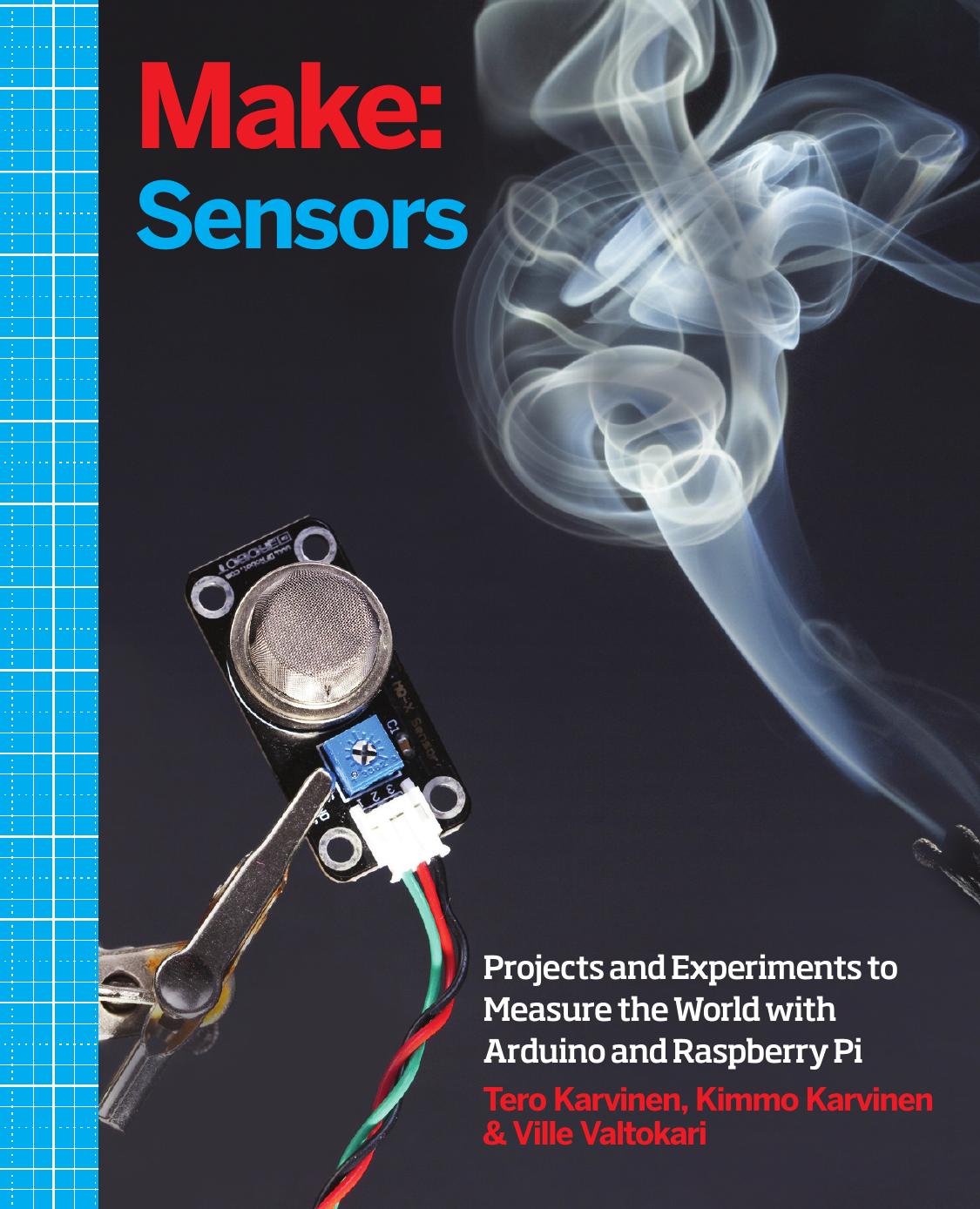
Author:Tero Karvinen, Kimmo Karvinen, and Ville Valtokari
Language: eng
Format: mobi, pdf
Tags: TECHNOLOGY & ENGINEERING / Sensors
ISBN: 9781449368050
Publisher: Maker Media, Inc
Published: 2014-05-05T16:00:00+00:00
Gyroscope
Angular velocity
Change of angle, spinning
rad/s (SI), often deg/s or RPM
Ignores gravity
Experiment: Accelerate with MX2125
MX2125 is a simple two-axis acceleration sensor (see Figure 8-1). It reports acceleration as a pulse length, making the interface and code simple.
The real, physical world is three dimensional. Objects can go up and down (y), left and right (x), and back and forth (z). A two-axis sensor only measures two of these axes.
The MX2125 only measures up to 3 g per axis. But some sensors can measure extreme acceleration. For example, the maximum measured acceleration of the ADXL377 (200 g), is much more than would kill any human. Thus, it’s more than is experienced in a shuttle launch or high-g maneuvers in fighter jets. It could measure an object accelerating faster than a bullet fired from a pistol. When we made an early prototype for an Aalto-1 satellite sun sensor, even the satellite spec did not require acceleration this tough.
It’s unlikely that you would need to measure such an extreme acceleration, and it would probably not be possible with a breadboard setup (because the acceleration needed to test would shake your project apart!). The cost is quite minimal, though. However, the wider the area of measured acceleration (from -250 g to +250 g), the less precise the device is.
Download
Make: Sensors by Tero Karvinen Kimmo Karvinen and Ville Valtokari.pdf
This site does not store any files on its server. We only index and link to content provided by other sites. Please contact the content providers to delete copyright contents if any and email us, we'll remove relevant links or contents immediately.
The Mikado Method by Ola Ellnestam Daniel Brolund(27124)
Hello! Python by Anthony Briggs(25975)
Secrets of the JavaScript Ninja by John Resig Bear Bibeault(25321)
Kotlin in Action by Dmitry Jemerov(24423)
The Well-Grounded Java Developer by Benjamin J. Evans Martijn Verburg(23613)
Dependency Injection in .NET by Mark Seemann(23333)
OCA Java SE 8 Programmer I Certification Guide by Mala Gupta(21964)
Algorithms of the Intelligent Web by Haralambos Marmanis;Dmitry Babenko(20871)
Grails in Action by Glen Smith Peter Ledbrook(19890)
Adobe Camera Raw For Digital Photographers Only by Rob Sheppard(17091)
Sass and Compass in Action by Wynn Netherland Nathan Weizenbaum Chris Eppstein Brandon Mathis(16851)
Secrets of the JavaScript Ninja by John Resig & Bear Bibeault(14491)
Test-Driven iOS Development with Swift 4 by Dominik Hauser(12602)
Jquery UI in Action : Master the concepts Of Jquery UI: A Step By Step Approach by ANMOL GOYAL(11877)
A Developer's Guide to Building Resilient Cloud Applications with Azure by Hamida Rebai Trabelsi(10664)
Hit Refresh by Satya Nadella(9259)
The Kubernetes Operator Framework Book by Michael Dame(8600)
Exploring Deepfakes by Bryan Lyon and Matt Tora(8457)
Robo-Advisor with Python by Aki Ranin(8395)
